

PIONEERS AND PILLARS
A SIMPLE FRAMEWORK FOR CONSIDERING THE TYPES OF ORGANISATIONS WE ARE SURROUNDED BY TODAY AND WHAT WE WANT TO BUILD FOR THE FUTURE.

“Do unto others and you would have them do unto you.”
Luke 6:31
PIONEERS & PILLARS
This is a simple framework for considering the types of organisations we are surrounded by today and what we want to build for the future.
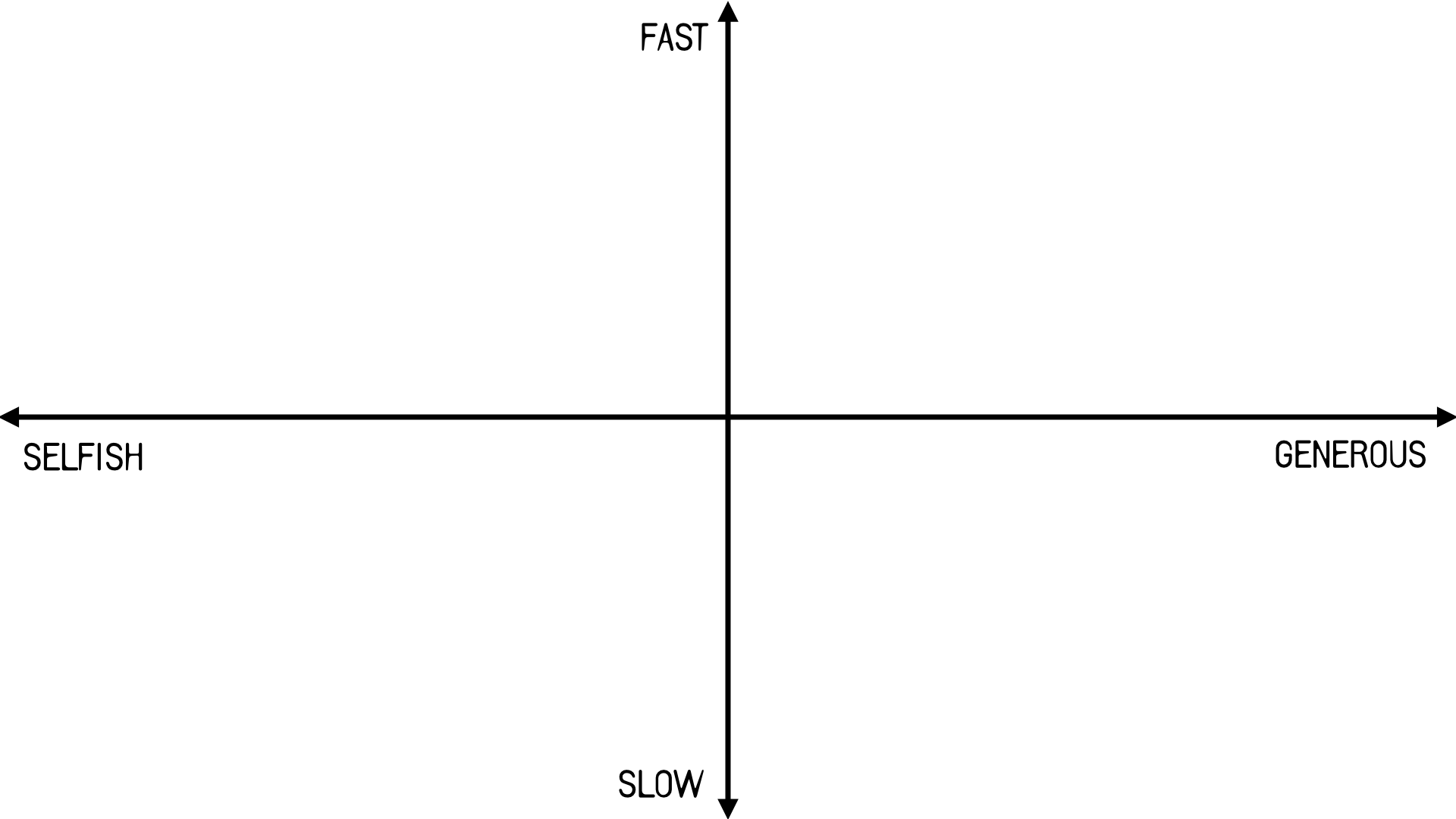
There are two axes:
X - SELFISH & GENEROUS
Referring to how an individual or organisation behaves in relation to the ecosystem surrounding them. Are they focused purely on their own self-interest, at the expense of the collective, or are they generous and distributive of value and ideas to the group?
Y - FAST & SLOW
Referring to how quickly an individual or organisation moves, their ability to process new information, build and deploy capabilities, pursue opportunities. This is closely linked to the way they use technology which is a force and speed multiplier.
PREDATORS & PARASITES
Entities that are Fast and Selfish are defined as Predators.
An example would be a Big Tech company such as Apple which is run entirely for shareholder return, uses extractive business practices like slave labour in its supply chain and accrues increasing amounts of power and information purely for its own benefit. These organisations move quickly, are ruthless in their decision making and use technology to subjugate and extract.
Entities that are Slow and Selfish are defined as Parasites.
An example would be a supranational government body such as the UN. It is slow, indecisive, lumbering and poor at planning and execution. It is terrible at building and deploying technology. It is funded entirely through taxation, meaning it creates no wealth and is entirely extractive and parasitic in nature. Parasites are run purely for the benefit of those who work within them, delivering little to no value back to society.

PIONEERS & PILLARS
Entities that are Fast and Generous are defined as Pioneers.
They blaze a trail for the rest of humanity and make sure to share their wealth and knowledge with the community that surrounds them. They do not need to do this under duress from parasitic entities in e.g. government, but understand that their own success and prosperity is dependent on the success and prosperity of those surrounding them.
An example of a Pioneer would be Linus Torvalds, the Finnish engineer who created the open-source Linux operating system that provides a free, privacy-first alternative to mainstream technologies created by Predator corporations such as Apple, Microsoft and Google.
Entities that are Slow and Generous are defined as Pillars.
Although they may not set the pace in terms of innovation or new technologies, they are a crucial foundational component of society. In fact everything we have rest on top of these reliable, stable Pillars.
We should, in theory, be able to point to organisations like the BBC as examples of Pillars. But unfortunately those days are long gone (if they ever existed) and instead we must look elsewhere. I will choose the example of UK Column (with the caveat that I work for them) as Pillars (Columns?) on whom we can depend.

HOW TO BUILD PIONEERS & PILLARS?
It should hopefully go without saying that we need more Pioneers and Pillars and fewer Predators and Parasites. There are a number of ways we can build and support them in the emergent system:
1. Open-Source
Open-source is a distributed software development model that encourages open collaboration. A main principle of open-source software development is peer production, with products such as source code, blueprints, and documentation freely available to the public.
This can be applied more broadly, not just to computer code. And it is one of the main methods we'll be using at PATTERN to accelerate distribution of successful civilisational models.
2. Social Enterprise
Instead of operating on a purely 'for profit' basis, businesses should adopt a more socially-minded approach which directs a portion of profits and / or activity towards community initiatives that benefit the collective.
Our view is that social good should be baked into your operating model, as opposed being delivered via a tax or tithe imposed on you by an external party such as a government.
Importantly, this should be done voluntarily and not enforced by an external party.
Be good to those around you, it will pay back in the long term.
3. Local investment
Building local systems and capabilities that serve local people is a crucial step towards ridding our society of Parasites and Predators. Global investment funds, in particular, are bad news. Foreign capital = slavery.
"A friend of mine, Nathan Gray, was once an aid worker in Guatemala. He told me of his frustration with agencies that would arrive with the intention of “creating jobs” and “increasing entrepreneurial abilities” and “attracting outside investors.” They would walk right past the thriving local market, where small-scale business people of all kinds, from basket makers to vegetable growers to butchers to candy sellers, were displaying their entrepreneurial abilities in jobs they had created for themselves. Nathan spent his time talking to the people in the market, asking about their lives and businesses, learning what was in the way of those businesses expanding and incomes rising. He concluded that what was needed was not outside investors, but inside ones. Small loans available at reasonable interest rates, and classes in literacy and accounting, would produce much more long-term good for the community than bringing in a factory or assembly plant from outside."
Donella Meadows, Thinking in Systems
We must make conscious efforts to buy from companies who are not owned by global funds such as BlackRock or operated from global or regional headquarters that are disconnected from local communities.
In the short term, this will be more difficult than you think...
4. Embrace symbiosis
It's crucial that we remember and honour the mutually dependent, symbiotic relationship that exists between all participants in a system. This isn't just about appealing to ethics, but also to self-interest. If those around you are doing well, then you'll do well.
Building this understanding into our own efforts, and transacting with others who do the same will accelerate the process of creating Pioneers and Pillars who can be relied on for long-term prosperity.
And never forget the Golden Rule:
“Do unto others and you would have them do unto you.”
Luke 6:31
Join the discussion at pattern.mn.co
Join us on Telegram
E pluribus unum.
Ben Rubin
PATTERN